Sunday, July 20, 2008

Penguins, Archaeologists and Temples

Finally I have got my computer sorted out and am able to now post photos (I hope). Hopefully this will add a completely new dimension to the posts and give you a little taste of what I am actually SEEING while over here.

This whole week has been very exciting not only for me personally but for the excavation. We started off this week with a trench that was on a million different levels. It was terraced in so many different places that the whole thing looked like a big mess. We decided to clean things up and try level out all the different excavation units to the same place, hopefulyl allowing us to avoid contamination from different periods. This sounded like a very solid idea to all of us sop we attacked it with gusto. Unfortunately, on Tuesday we uncovered a very large and very flat rock just sitting in the middle of our trench. Many expletives were uttered by the trench supervisor, as this kind of stone is the tell tale sign of a cist tomb and involves monumental amounts of paperwork. The rest of us were actually quite excited about the whole thing.


Needless to say, this diverted attention completely away from our original plans, and work was now focussed on clearing the trench around the grave so that the mortuary excavators could come in and open the grave. Curiously, code words have to be employed when we are not at site and talking about graves because we do not want the locals to think we are finding gold or anything of value. It would lead to looting and crowding of the sight and ultimately damage to the archaeological record. For these reaosns, we call graves 'Penguins'.

This was started on Wednesday afternoon, and things quickly became interesting. The tomb was intact, but the bones were pretty badly preserved. The Mortuary people could tell that it was the grave of a 6 or 7 year old, but gender was difficult to be sure of. Amongst the bones we found a number of really amazing grave goods. About 7 completely preserved pottery vases and jugs were found, all beautifully decorated in very good condition. On the actual body itself were found a bronze ring, two bronze bangles and two bronze pins to either hold hair or clothing in place. The date of the grave is from the Protogeometric period, the period directly after the Mycenaeans starting from about the 10th century BC. All in all we are told that it is one of the best preserved graves from our site, and it is very rare to find one that hasnt been robbed.


We also went to a site called Kalapodi, jsut down the road from Tragana. It is being excavated by the Germans and is alarge temple complex ranging in use from the Mycenaean period all the way through to Roman times. It is quite an impressive site and very well preserved. The Germans are CRAZY. Their baulks look like they have been cut by a lazer. They are so smooth and sooooo clean that you could literalyl eat off them. You can see everything with regards to the different soil layers and layers of occupation. I was quite jealous and will now strive to be German.

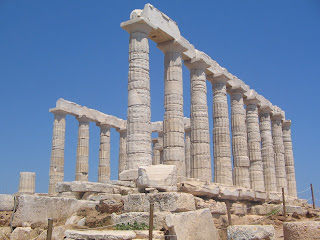
The weekend was planned to be very exciting. I was to meet up with some of my university friends who are digging at the Isthmia at Corinth. We were to rent a car and drive all over southern Greece visiting Sparta, Pylos and Epidaurus. Unfortunately, while we did manage to meet up without amny problems (a monumental achievement), our plans were cut short when we could not find a single place at the airport which had the right kind of car we needed. THis put our entire plans into a tail spin as we had to now rely on public transport, which we had NOT been planning on. We had to wing it. After much deliberation and trudging all over Athens, we eventually found the bus stop to Sounio, a little town on the southern coast of Attica. Its claim to fame is the majestic Temple of Poseidon, poised on a cliff face overlooking the Aegean sea and the island of Aegina. The whole setting was incredible, and the view spectacular. I am sure that even a god must have been pleased.


We made our way back to Athens and I showed my friends around the Plaka area (I swear I know Athens like the back of my hand now), before heading to the metro station to make the long trip to Corinth via train. We arrived quite late and managed to have an amazing meal right on the water front. The next morning we decided to head into the Corinth markets which are pretty much jsut the weekly farmers markets. We managed to grab some amazing tasting fruit for breakfast (not to mention the GLORIOUS home made turkish delight). The markets were busy but very charming. We enjoyed them immensely. The plan was then to head to Loutraki, famous as one of the prettiest beachfronts on the entire gulf. We managed to figure out the bus routes there and arrived without much hassle, but found that the whole place was much to busy to be enjoyed and returned soon after. We also found out that it would be impossible to go to the Theatre of Epidaurus later that evening to watch a play because some famous French orchestra was playing there and the tickets were completely sold out. I was very dissappointed about the whole day but it was amazing to hang out with Rennie and Jennie again.


Today has been quite low key. After a big night last night durting which much Beer Pong was played and alcohol consumed, Rennie and Jennie decided to take me around Ancient Corinth, and we managed to get permission to go behind the barriers into the Peirene Fountain because 'they were doing research'. One of the greatest moments of my life was when we were stopped and asked what we were doing. We jsut looked at each other and replied, 'We are Archaeologists with the American School and we are doing some research on the Fountain.' they let us pass immediately. The great thing was. It wasnt a Lie. We are archaeologists :D:D

Sunday, July 13, 2008

Halfway (and a bit) Point Already!?

After the adventures of Napflio last week, it was always going to be hard to come back to the routine of dig life. This whole week has been quite the struggle for me personally. The mind is willing but the body seems to be in a state of revolt. I ahve been trying to go to bed early enough that I get decent amounts of sleep, but I am quickly discovering that getting anything more than 5 hours and less than 9 is a death sentence. When you wake up you feel like death. Every single muscle in your entire body screams at you and it feels like you are trying to pull yourself out of a bath of honey (not that I have ever had that experience......). It took what felt like an iron will and the strength of ten men to pull myself out of bed and into a breakfast chair in time for some tea and yoghurt.

As it turns out, it seems that the reason for this horrible siutuation was that I was sick. This came to full fruitation on Tuesday night when while lying in bed, I was shivering with cold. I looked around and noticed that everyone in the room had not even bothered to put on their sheets and were jsut sleeping in boxers because of the heat. I rolled over and muttered to myself 'this cant be good' and proceeded to pull on a blanket and a jumper. I woke up in the morning with a monumental effort and immediately rushed to the bathroom. I wont go into any details but suffice to say, bad diahroea is just not pleasant in any way. I was in no state to go to breakfast let alone to the site, as my brain was feeling like it was going to explode out of my head. I called the field school director and was told I could stay home for the day. I proceeded to get to the local pharmacy, got some meds and then collapsed and didnt move for most of the day. It proved an absolute blessing. The next day I was feeling a million times better, and was pushing very hard to go to the site. Nick relented but put me on flotation duty to make sure I was ok. I didnt mind as we had a good team there that day and got through a lot of work.

The reason for me wanting to get back to digging so soon was due to the amazing things we have managed to pull out of our trench this past week. Not only have we come up with gigantic remains of storage vessels and huge pieces of pottery, but we have also found a beautiful phi-figurine (the best found on site so far). Enough about ceramics though! Much to everyones excitement we have also managed to pull out a bronze dagger, almost fully intact with a point. It is very well preserved, as usually when these things come out of the ground they are badly damaged and shattered. It is probably about a foot long. The best find of the week, and indeed probably of the entire season so far, was a beautifully engraved seal stone. These stones acted as administrative seals or signatures left on clay seals on pottery vessels. More importantly, is that the one we found is in context which means it is infinitly more valuable than other seal stones found on the site so far (which are only 2 or 3 and all found through sieving). Needless to say, the moral in our trench is sky high and we can't wait to get back to digging deeper. The mantra of archaeology and indeed the answer to almost all our questions seems to be: 'dig deeper, we will see..'

The weekend trip this time was around Boetia, which is pretty much within a 50 km radius around home, so it was jsut a day trip. We started out visiting the Mycenaean fortress of Gla which was very impressive in both size, architecture and use. Around Gla is the famous Kopaic Basin, which was completely and ingeniously drained in Mycenaean times by diverting the flow of six whole rivers into surrounding fissures in the ground and forming a gigantic and extremely fertile plain. Gla was probably used to guard the surrounding countryside. We visited one of these huge fissures in the surrounding mountainside, and were suitably awed. We then made our way to the town of Orchomenos, which may very well be the controlling centre which had power over our own site of Mitrou in antiquity. There wasnt much to see there as the modern town is over much of the site itself, but a very large and well built beehive tholos tomb is still around, which I must say seemed to me to be of much better quality than even the ones at Mycenae. We then made our way to the site of the battle of Chaeronea. *insert MAJOR Ancient History Tingles*. Charonea is the place where Philip of Macedon and Alexander the Great (in his first battle) defeated the combined forces of Boetia and Athens and gained a measure of control over Greece. It was also here that the fanatical courage of the Sacred Band of Thebes was displayed as they stood firm against Alexanders charge and were killed to a man. I love it! :p

I then decided to stay on and join in some of the optional trips as we went to Thebes and Leuktra. Thebes had nothing to display as the entire city is lying directly over the citadel. It is a shame because what has been gathered by rescue excavations suiggests that it may have been Thebes and Not Mycenae who was in charge of the entire Mycenaean world. It would answer many huge questions if Thebes could be partially excavated. Leuktra was jsut as amazing as Chaeronea, if not more so. It was there in 371BC that the Thebans inflicted on the Spartan Army its first ever complete defeat and shattered the aura of invincibility that surrounded them up to that point. It also marked the end of Spartan domination, and the beginning of Theban leadership over Greece. I lvoed it, even though it was only an open plain and a small monument.

The trip was the longest we have been on so far, even if it was only locally, and we only got back around 8:30pm. I went out to the butcher shop for a well earned meal and then retired to bed for some more sleep.

PS> GO THE SPRINGBOKS! We shall not speak of the cricket.

Monday, July 7, 2008

Napflio and the Argolid!

The fourth week of excavation was very easy for me personally. The way the field school works is on a rotational basis. Different tasks are rotated out to different students on a daily basis. This means that you normally spend about 4-5 days in your trench, and 2 days out doing other tasks. Unfortunately, due to the amount of walking wounded we have at the site due to injuries and illness, I have been permanently on site in my trench since the first week. This meant that I had a backlog of Apothiki, Flotation and Surface Survey duty that pretty much all got taken care of last week.

Work at the Apothiki involves lots of pottery washing and flot sorting. This is quite possibly one of the most mindless jobs ever invented by human kind, but it is essential to the smooth running of the dig. Flotation work is also fairly annoying. It involves wet sieving all the soil that has already passed through a dry sieve, and skimming off the scum that floats to the top which tends to be plant or carbon remains mixed in amongst lots of contaminants. You dont get to see much reward for all your effort but you do get very very wet, which is an absolute blessing in heat that can get up to around 50 degrees. Surface Survey has been described by many as hell on earth, mainly because you are forced out into the blistering sun with no shade to rake up long grass and weeds and pick up any artifacts off the surface. Unfortunately this is also probably the most important activity out of these three as it allows us to gauge the archaeological potential of an area. My week pretty much consisted of these 3 activities in a row, and then a day of trench work. I was actually extremely thankful for the break though as I was developing some worrying symptoms. I had a really sore throat at one point, as well as a continuously bleeding nose when it was blown. Coughing was also frequent. I got bundled into the car and taken to a medical clinic in the next town along with some other invalids but was assured that I was fine, and all I needed to do was try shield my breathing from all the dust. Im back to 100% now!

We had friday off from the site as we were heading to the beautiful Venetian city of Napflio in the Argolid Plain of Greece for the weekend. I have looked forward to this partiucular weekend trip more than anything else in Greece and was extremely excited. I dont QUITE know how you manage to wake up early for a trip that is supposed to leave at 6am in the morning but I managed quite well. The Friday morning we had a 4 hour drive towards Napflio but we had stops to make on the way. Our first stop was the amazing site called Korphos. This is a BRAND new site, that has only had preliminary survey work done on it. The American School funded project was actually on its final day for the season while we were there and the two co directors offered to show us around the huge 8.5 hectare property. The place was a shambles. Rocks were EVERYWHERE. At some points you couldnt step on the soil even if you wanted to. Still it was one of my favourite sites jsut for the sheer potential of what they are sitting on. I am going to try see if I am able to apply to work there for their next season where they will hopefully be opening up some test trenches.

We also visited Epidaurus with its Asklepion and theatre before heading to check into our hotel at Napflio. We were at Napflio for barely 2 hours when a few students and myself decided to tag along with our Field School director to visit a place called the Kastro Larissa about 20 minutes away. this is a huge Byzantine or Frankish castle (im not sure which) that stands on a large promontary that overlooks the ENTIRE Argive plain. The view was astounding. You could literally see EVERYTHING. I could make out the Mycenaean citadels of Mycenae, Tiryns and Argos, the Argive Heraion, Napflio, and of course the Meditterranean. On a map all these things have always looked so spread out, but it was surprising to find jsut how close everything was to each other. Greece is a small country. From this spot we were clambering all over the battlements and towers of the castle, as we had the entire site to ourselves. We watched a breathtaking sunset and took some impressive pictures before heading back to Napflio to grab some dinner (sweet glorious pizza again).

The next day was a very exciting one as we were headed to Mycenae. I have been there before, but never with someone that knows so much about the architecture and history of the place. We were also lucky enough to be taken around by one the the archaeologists that is digging there this season. Not only was she able to take us behind the scenes into the 'barred from public display' cult centre of the citadel, but she also took us to her trenches and gave us a site overview and tour. It was really good to have such inside access and go behind all the locked doors and gates! We also stopped off at the traditional tourist spots of the 'Treasury of Atreus' and Clytemnestra's Tomb' Tholos Tombs.

That afternoon, after coming home exhausted, I took a couple of hours to rest and hydrate and found an internet cafe in Napflio. Unfortunately the computer that was given to me had a space bar that wouldnt work so unfortunately, blog posting wasnt very successful. 4 of us then decided it would be a GREAT idea to climb to the top of the Venetian Fortress above Napflio. We made the trek up the 900 odd steps to the entrance to the fortress and found to our horror that it had closed about an hour earlier. Now, we were feeling pretty annoyed at this time due to the lack of signs communicating the situation at the BOTTOM of the steps. We were also feeling extremely adventurous and moderately irresponsible. We decided to climb over the walls (as safely as possible of course) and get inside. We did this without much trouble and had the entire fortress to ourselves. We explored around for about 3 hours or so and watched the most beautiful sunset I have ever seen over the city of Napflio from the battlements. It was one of the most incredible moments of the trip so far and completely worth the risk of getting caught. We made it down safe and sound with the authorities none the wiser, and proceded to find ourselves some food before collapsing into a dreamless sleep.

The next morning, we had a busy day ahead of us and we prceded to the Mycenaean Citadel of Tiryns. I wont go into the specifics of the visit but the most interesting and terrifying aspect of this visit was the near fatal accident that occured while we were near the Cyclopean Walls. Inside these walls are great storage rooms and some of the students were inside one when someone must have knock a wall. This caused a very large block of Cyclopean masonry to become disjointed from the roof and plummit towards the group. Luckily it moved fairly slowly and the girl was able to dodge out of the way in time before the huge block came crahsing down. Everyone was safe. The rest of the day unfolded at a more sedate pace as we went to places like the House of Tiles at Lerna and the Museum of Argos before heading home to Tragana.

WHAT A WEEKEND!

Monday, June 30, 2008

We are the Grovenians, we come in peace.

The third week of excavation began with the express intention of 'plowing' through the plow zone and finally getting rid of it. I was feeling really good on Monday, thanks mainly due to the weekend, and was ready to work really hard. However, as soon as we got on site I was approached by the Dig Director and instructed to pack up my things and move over to a new trench down in the Olive Grove. I had mixed feelings about this turn of events as I was really enjoying working with Dave, but when the Dig Director tells you to do something you simply dont question it. The reasons they decided to move me seem to be the fact that they were lacking a strong digger within the area, and mostly because the research project I have decided to undertake while I am here deals with the time period that the Olive Grove seems to directly focus on.

This trench is one of the more exciting trenches on site. In 2006 they uncovered incredibly good quality pottery from the same time period as the shaft graves at Mycenae which is very rare to have in a settlement context. Controversially they also seem to have some evidence for the largest and earliest ship in Bronze Age Greece within this area. it is an incredibly rich depost that hopefulyl will yield many fantastic finds throughout the season. Unfortunately the trench is located very much away from the central excavation area. As a result we are somewhat segregated and it feels most of the time like we are a completely seperate group. We prefer to be referred to as the 'Grovenians'.

Upon my arrival at the trench I discovered that some backfill still needed to be removed in this area. With much moaning, groaning and sweating this was swiftly removed and we were soon ready to break ground in the new trench. I cant get over the excitement that comes wiht the first swing of the pickaxe. It is truly fantastic. I suppose its the little things that make something memorable. Excavation continued throughout the week with very few significant finds as we were once again moving through the plow zone. Some interesting things uncovered were a piece of a lead bracket, a loom weight and, very commonly, some extremely high quality pottery. On the Wednesday, we decided to work ridiculously hard and do a 50 cm pass throughout the trench to try and get past the plow zone. This we accomplished much to the amazement of the rest of the crew, and in doing so we broke a record for the most amount of soil moved within a single day (233 20L zambelies to be precise. You can work that out in your own time :p). This was not to the detriment of accuracy, as we still managed to pick out about 7 pails of pottery. Needless to say I loved the work, but my body was absolutely destroyed for the rest of the week. At the end of this 50cm pass we uncovered a large mudbrick melt surface that seemed to extend across the entire trench. This slowed down our excavation substantially as we concentrated on tracing the surface. Many very large pieces of pottery were revealed within this melt layer so we think that this was perhaps used as some sort of surface.

On the Thursday night of the week it was the 21st birthday of one of the trench assistants (Tyler). We all went out to celebrate and had an absolutely fantastic night out. It made fridays excavation incredibly interesting as everyone was moving at about half pace. I made the silly decision of trying to work through any remnants of a hangover, and while this resulted in me working probably harder than normal, it also resulted in me being too tired to keep my eyes open at dinner. Sleep was goooood.

The weekend consisted of a field trip to the large island of Eubea just to the NE of us. The crossing was pretty awesome, as the island is only a few hundred meters off the mainland. We went to the site of Lefkhandi, Eretria and Chalkis where we saw a canal that was only about 20m wide seperating the mainland from the island. I was not VERY interested in the sites but still had a good time. Saturday evening was completely out of control as it turned out to be the dig directors birthday. Considering he knows almsot the entire town personally there was a big party planned down by the beach bar. At some point in the night, huge watermelons were brought out that had had their centres semi-liquified and some concoction of alcohol poured inside them. This juice was then ladled out into shot glasses and systematically destroyed by the entire bar. It was a lot of fun and despite the temptation of hollowing out the empty watemelon and fashioning a helmet, ended up being completely harmless. It was an incredibly late night and we only ended up getting to bed at around 6am. Thankfully the next day was a free day and we could sleep it off without much trouble.

-----------------------------------------------

PS> I am having computer problems still but should be sorted out by this week. Photos will then be forthcoming. Apologies.

Thursday, June 26, 2008

Plow Zone, Pottery and Pizza

The rest of the first week of work at Mitrou went by very smoothly. We continued to take out all the remaining backfill and expose the trenches. We were all suitably exhausted by the end of the week, but the good thing about backfill is it exposes the hard workers and the slackers. It sort of serves as a bonding experience (Baptism through fire if you will). I actually quite enjoyed it despite all my grumblings. It is quite mindless work, and is extremely good exercise. You can just zone out and enjoy the workout. At the end of the week we had exposed and swept out most of the trenches on site. FINALLY our islet was looking like a functional archaeological site rather than a quarry.

Friday night was reason enough for a mini-party down by the beach, and almost everyone turned out to bring in our first weekend. We enjoyed ourselves suitably, as only University students can, and got to know everyone on a different level away from the dust and grime of the site and the mugginess of the Apothiki. Conveniently one of my roommates, Doug, has some sort of psychological problem. If he has had enough to drink, he will compulsively buy beers and alcohol for almost anyone around him. Needless to say, I figured this out very early on in the night and proceeded to act appropriately. It was a good night.

The weekend was spent travelling to the nearest town, Atalanti, and visiting a couple of interesting mini-sites and the museum. The museum houses the most important finds from the entire Ephoria (or archaeological district). It was really good to check it out. I have forgotten how much of an absolute nerd I can be when it comes to museums. I can get lost in them for hours and hours.

The rest of the weekend was free time, so I enjoyed the break and spent most of it hanging out on the beach and reading/researching for a paper I want to write while I am here. The break was much needed and welcomed.

The second week of archaeology was extremely exciting. This was not due to many significant finds or anything like that, but mainly because of the novelty of actually starting to excavate for real. A couple of students and I were assigned to a trench with Dave, Ainsley (both trench assistants) and Beth (our supervisor). We started with a detailed surface survey, and finally broke ground for the first time. That first pick axe swing was magical. If it was in a movie, it would have either a) been done in silhouette or b) been done in super slow motion with inspiration music playing in the background.

Unfortunately, the novelty pretty much wore off very quickly. We were digging through a layer called 'plow zone'. This is the entire layer of soil that has been ridiculously disturbed. Almost all of the things we find in this layer are tiny little sherds of pottery, ranging in size from a pinky nail through to palm sized pieces. As in archaeology, context is almost everything, these pieces are pretty much useless to us even if they are good quality. Pieces of shell and bone are also found, highly disturbed and because of this, we tend to try go through this layer quite quickly. Unfortunately it can be meters deep at some points, so it is extremely frustrating.

A couple of interesting things did come up though that I was very proud of. On the first day of excavation I managed to spy a piece of really high quality painted Mycenaean pottery that my trench assistant had compeltely missed. As a result I was named Eagle Eyes for the rest of the day. The next day, I was taking out some stones that we had determined were jsut floaters (big stones that werent part of anything significant), and was picking underneath one when I discovered almost half of a really large bull figurine. As our dig supervisor is making a particular study of these figurines I received massive browny points, further cemented my status as Eagle Eyes and received a free beer in the process. Unfortunately that also marked the end of my good fortune, and I did not find anything really special for the rest of the week. Worse still, we soon lost Beth and Ainsley to a more "important" trench, and Dave was left in the deepend trying to supervise a trench. He hasnt had any experience doing this, so he is struggling. I enjoy working with him though and I am learning a lot from his mistakes (which to be honest have been few and far between).

That weekend we went on a weekend trip to Athens. We were shown around the sites of the Agora, Acropolis and Keremaikos (ancient cemetery) of Athens by the actualy archaeologists who are the dig coordinators for the respective sites. As a result, we were allowed behind locked gates that usually bar the public, and into the actual trenches to have a look see. It was incredibly exciting as these guys really put the history into perspective. One of the best moments was standing in the middle of the 'Stoa Basileus' and realising that almost everyone I know from Greek history had once had office there and administered the city of Athens, or visited on some sort of political business. The same was true for the Parthenon. It was truly spine tingling stuff. Some of the greatest and most ingenious men to have ever lived had stood in exactly the same place as I was standing. *insert ancient history tinglies here*

The rest of the Athens trip included a visit to the National Arhcaeological Museum. Naturally I spent about 5 hours wandering around the different rooms and I loved every minute of it. That Saturday night, while some were preparing to hit the clubs in Athens, I decided to have a low-key night with some of the guys and we went on a search for some form of Pizza. You do not understand the craving. We have had ham and cheese for breakfast, second breakfast, and lunch for almost 2 weeks in a row. I was ready to KILL someone for something that tasted good. We eventually found a great pizza place (intriguingly, Pizza Hut here in Greece is a posh restaurant complete with wine lists, appetisers, deserts, music, candles, everything. It was amazing) and proceeded to really splurge. I think we ate enough to last us for a couple of weeks :D.

We would need it.

Friday, June 20, 2008

Mitrou: It Starts

The last 2 days of archaeology have been intensive. After waking up to a very late start by dig standards on the first day, we headed down to Straboula’s, the restaurant and owner who has been burdened with providing the entire dig team with breakfast, lunch and dinner. Here there was a buzz of excitement as everyone could not wait to get onto the site and working. We had a few quick introduction and orientation speeches, also detailing the context of Mitrou within history which were incredibly fascinating. I had not realised just how amazing Mitrou itself is. Some of the things that they have found here add to cutting edge research and theories in todays academia. This is not just ‘another site’, but something that is unique and can answer some very tricky questions.


At the conclusion of the speeches, we all piled into an assortment of vehicles along with equipment and headed down to the beach. Mitrou is a tidel Islet about 20 meters off the mainland. It was not always an island, but a REALLY big earthquake in the late 1800s altered the landscape so completely that the fields around the site were covered with water, and made into a large bay. As a result the archaeological site itself extends quite a far way into the water.


To get to the islet, we have to wade out every day into water that can be up to knee deep. It really adds to the whole charm of the place. We had to walk quite a few meters inland to the trenches and pits that have been dug. The site of Mitrou is so big that in 6 years of excavation, they have only uncovered 2.1% of the islet which means that there is still an incredible amount of potential archaeological wealth still available. We got quite a shock when we arrived. The place did NOT look anything like we were expecting (although I am truly not sure what we were expecting exactly). Long Grasses had almost completely covered the site. Large mounds of backfill were dotted all over the place, and weeds were rife. This is the price that a seasonal dig site pays.


After a quick tour of the island, we were put to work. We grabbed whatever tool we felt we needed and began to clear away all the scrub and weeds off the sides of the trenches and pits. This was very hard work as the vegetation was incredibly thick in some places. Finn (assistant trench supervisor), Mary-Page (student), and me decided it would be good to work as a team and we had a good system in place. We were quickly making progress until Kerril (Dig Coordinator) noticed and decided to put us to work building a road. Kerril made building a road sounds quite rewarding and sort of fun. Oh how wrong we were. The road was supposed to be up a mound to the side of the site, where dirt and debris from all the trenches were dumped last year. Obviously the trend was to continue but there was a problem. The mound had been completely COVERED by a thick layer of very stubborn grass. We were there shovelling, hoeing and rakeing for much of the 6 hours we had on site. It was extremely backbreaking work in quite hot conditions. The sun is fierce and at this stage of the excavation, there is no shade tarpaulines in place. We made steady progress though and soon the mound began to take the shape of a large ramp.


It might be worth making break from the narrative here to describe a typical day on site. Work begins usually at 6:30am. We work for around 3 hours before we are given a Kalatzo (second breakfast) typically of fruits, yogurt and breads. Work then again resumes, and the sun is starting to get very hot. 2 hours later we are mercifully given a short Karpuzi (watermelon) break. We are told again and again how important it is to take advantage of the watermelon as it reduces the amount of water you have to have flowing through your system, and therefore decreases the loss of minerals and vitamins. I don’t normally enjoy watermelon but it is definitly helpful in getting through to the end of the day which comes 2 hours later at around 2pm. By now the sun is much to hot to safely work, and all of Greece goes into a 3 hour siesta from 3-6pm.

By the end of the day we were all utterly exhausted. I decided to take a swim, after work beer and shower during siesta which did wonders for my energy levels. At 6pm we had to meet for a quick hike some way up the mountains backing Tragana in order to have a look at some Mycenaean Chamber Tombs that had been excavated. Only 1 had not been backfilled, but it was very interesting to see. We will be going to a museum in the next town (called Atalanti) to view some of the things found there. While up the mountain we also had a formal introduction to the field school. The entire program sounds absolutely fantastic, and I will be throwing myself completely into doing as much as possible.

After this we went out to dinner to Strabula’s, and I turned in for an early night soon after.
The next day went by much the same schedule. Upon reaching the site, Ben and I (student and roommate) were commandeerd to help construct the shade tarpaulins because we were tall. While we waited for that to be organised I quickly helped Finn finish off what we still had to do on the road. We made extremely fast progress and soon the place was fit to be used as a ramp to the dump site. Finn continued to fiddle while Ben and I headed off to construct the tarpaulins. This job was extremely finnicky and ANNOYINGLY FRUSTRATING. We managed to construct 2 6x5 Tarpaulins and 1 5x5 before we were out of time. Yes, it took us almost the entire day. There is still quite a lot to do so we will in all likelihood continue in the morning.
After work on the site we had the afternoon free till dinner. I took advantage of the time to get to a computer and call my parents who had not heard from me yet. My baaaaaad :p

Wednesday, June 11, 2008

The Journey to Tragana

I was really excited to get going to Tragana. After spending the morning wondering around the national gardens and Syntagma square (the main square in Athens), the group decided it was time to get a move on. We had carefully planned our trip down to a tee, because precious little detail was given to us by the dig coordinators about how exactly we were to find the bus terminal that would take us to Tragana.

We lugged our luggage out of the hostel and said goodbye to the amazing staff there. I was the most economically packed of everyone there, and I was not having any trouble at all carrying my bags. The girls on the other hand (especially Maddie and Ashley) were completely over packed, and this made navigating the narrow streets and many stairs of Athens extremely difficult. Originally we had planned to take a bus from Syntagma square to the KTEL bus station in the North of the city, but we all felt that we should try for the trains instead as our luggage was hardly suited to inner city travel on the bus. I managed to figure out what station we should get off at, but was a little unsure as to exactly how to get to the terminal as all of our maps did not go that far north. We thought we would be able to figure it out.

Upon exiting the station, we wandered outside and quickly found that we were NOT in what you would call 'touristy' Greece. The streets were quite crowded and dirty, and almsot no one spoke english. Luckily I have managed to pick up enough Greek to be able to exchange pleasantries and also ask for directions. I was quite nervous but I managed to successfully ask one man how to get to the KTEL bus station. Unfortunately the Greek I know is extremely limited so his reply was very difficult to understand. Thanks to a mixture of hand signals and limited Greek I was able to get the general jist of what direction to go, so we set off. We actually managed EXTREMELY well. It was quite a far walk, but I stopped twice more for directions and they were all consistant so I was not misunderstanding. We managed to get to the bus terminal unscathed and quite early. Our tickets were booked and we settled in to wait for our bus to depart.

While we were waiting, another group of quite obvious Americans arrived and made their way to the bus. We followed them and boarded. Soon after we departed and were on our way toTragana. Upon our arrival we were shuttled into our seperate accomodations. Different families have vacated their houses for the dig. Most of the guys were sleeping in a house called Mixouris, right near where we eat our meals. We also have the luxury of having a wachine machine and hot water, but the detriment of having the most residents with all 10 guys staying there. It isnt exactly what you would call luxury accomodation but it is comfortable enough. Believe me, after a week of digging you would sleep on a cold concrete slab like a baby.

We were given a little tour of the town by one of the staff members, a returning student by the name of Dave or 'Jersey' as everyone calls him. We had a couple of beers at the local hangout called Zoe's, and were shown where the local general store was, an alternative place to eat and were introduced to some of the locals. Tragana is one of those small country towns where everyone knows everyone and despite not being able to speak Greek, we were being recognised by some of the more frequent locals and shop owners in no time.

After heading to dinner and being introduced to even more people, we headed to Zoe's for a social drink. I decided to accompany some of the retunring students down to the beach. Its a good 1.5 kilometer walk, but we were quite chatty and made short work of it. I was then taken to a local Taverna on the beachfront called Maria's where obviously she knew most of everyone. I was quickly singled out as the new face and subsequent celebrations of Tequila on the house were forced upon me. I am starting to realise just how generous the Greeks can be, especially if you are friendly. It was a fantastic time, and it was good hanging out wiht some of the more experienced people on the dig team. Some of the other students arrived a little later, which put another glow on Maria's face.

----------------------------------------

I now have very little spare time available to me to write blogposts. I have been trying my best, but as you have noticed I have fallen off a little bit and am quite far behind. As of now, I will post a little less frequently and roll a couple of days together in a little less detail. Stay tuned!